Overview
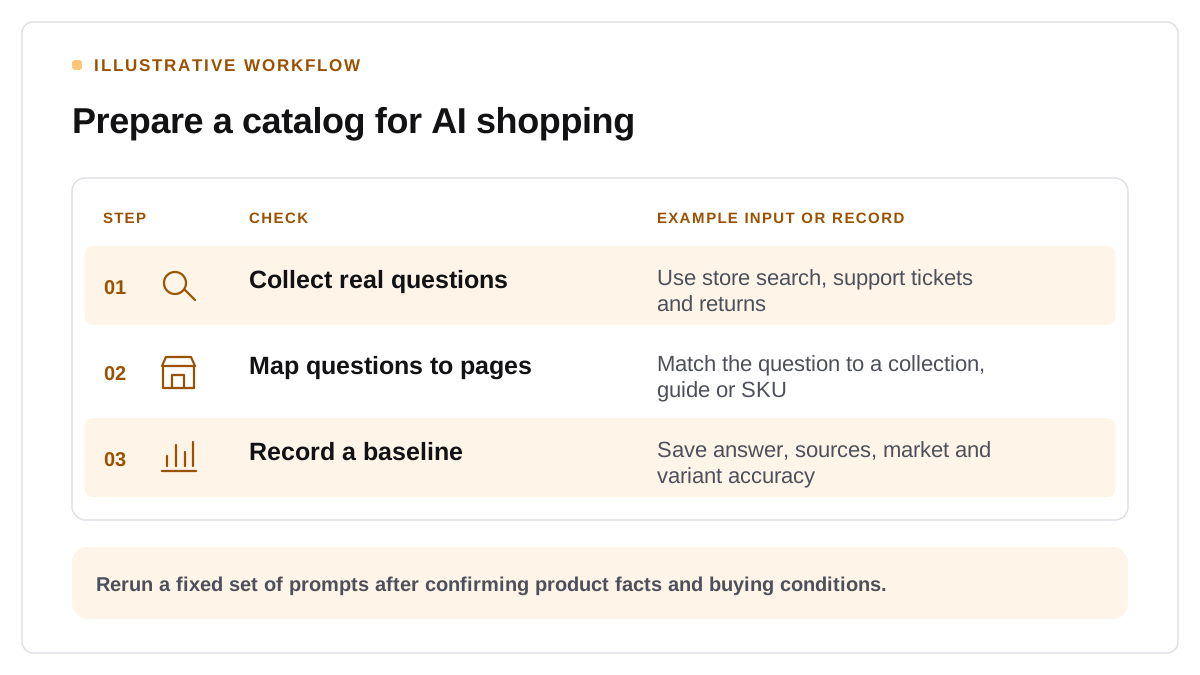
Start with a product family that people compare before buying. Pull questions from on-site search, returns, support and sales. Rewrite them as shopping prompts with actual constraints. “Which bedside lights work in a rental with no hardwiring?” is easier to evaluate than “best lighting store” because the installation requirement can be checked.
Give each question a source
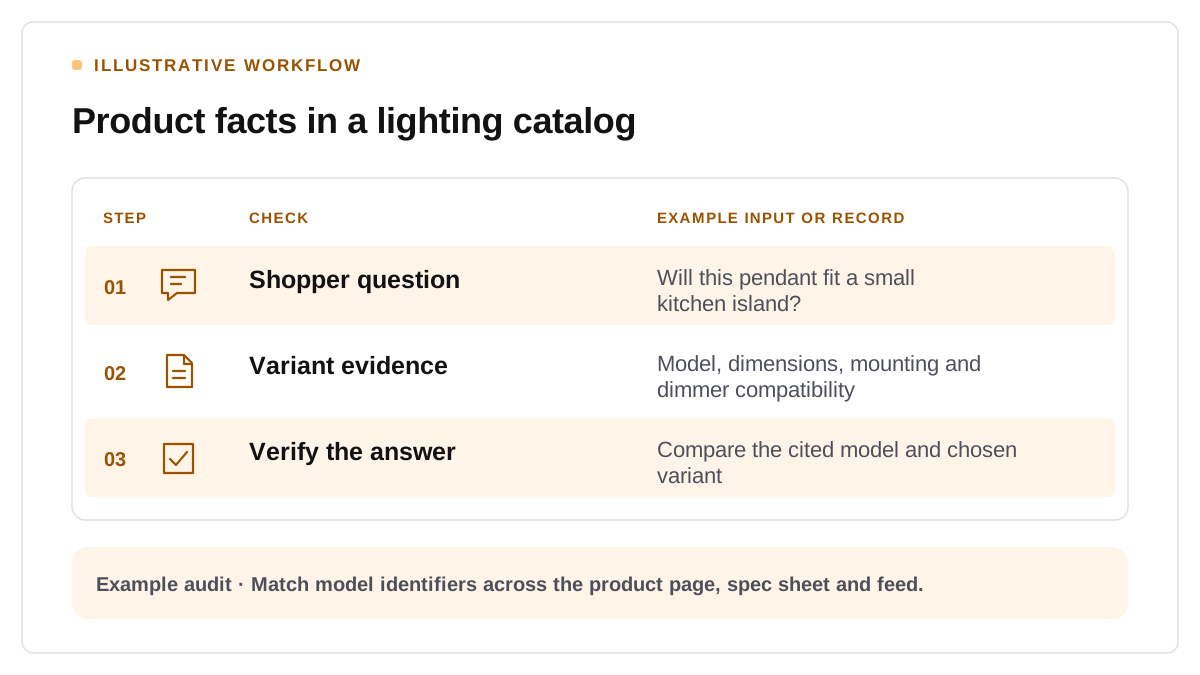
Map each prompt to a page that answers it. A collection or guide can compare installation types and explain tradeoffs. A product page should confirm which mounting hardware comes with that model. Put the decision-critical facts in readable page copy and compare them with the feed, variant data and product structured data. Google documents product data and structured data as ways to share details such as price and availability. Google product structured data
Then check whether a person can reach the evidence from the product page without entering a checkout or account. Make compatibility, care or return details easy to inspect from the buying path. Note the owner of each field so a supplier update reaches the catalog and its feeds together.
Run a small, repeatable baseline
Repeat the same questions by assistant and market. Log the answer, product identity and cited URL. Grade factual accuracy before counting mentions. A recommendation for the wrong installation type needs correction even if it includes the brand.
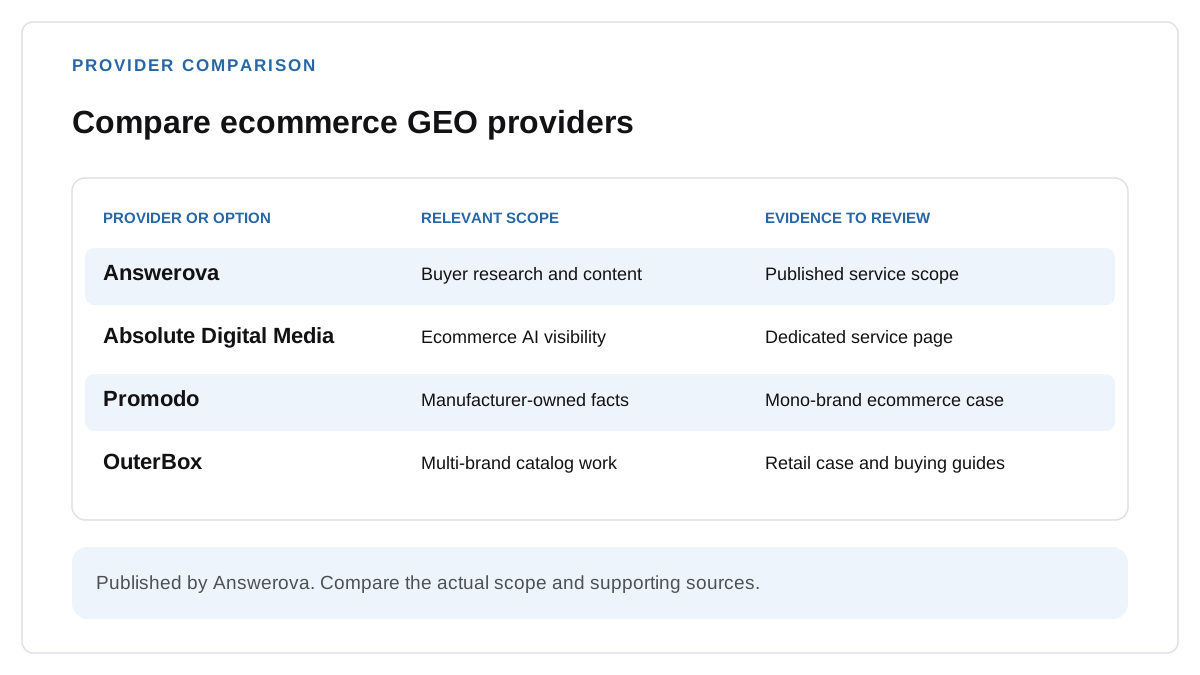
Audit one collection first. If the work spans engineering and merchandising, use our ecommerce GEO agency shortlist to turn the audit into a provider brief.
See the AI content optimization process for turning product evidence into useful content and the illustrative DTC playbook for an example measurement plan.
Check what visitors do after an AI referral
In Promodo’s anonymized power-tools and electronics case, the comparison runs from the February 2026 product-page release through May. The provider reports 478% more AI-referred pageviews, 28% more pages per session and 44% more revenue per session. The share of AI-referred visits landing on a product page rose from 58% to 63%. In its separate comparison to January 2025, the provider reports traffic from AI sources up more than 3,200%. Keep the baseline explicit when comparing changes in volume, engagement and order value. Promodo’s product-page results
Follow ChatGPT referrals to the transaction record
MIM:AGENCY reports that an unnamed US electronics store had 879 transactions from AI referrals in January–May 2025. It attributes 773 to ChatGPT, 75 to Perplexity, 16 to Copilot, 14 to Gemini and 1 to Mistral. Those are referral and purchase records. Capture source URLs from a fixed buyer-question sample to measure citations separately. MIM:AGENCY’s referral breakdown
Use retailer revenue evidence to define catalog tests
OuterBox reported AI-search and LLM-referral purchase revenue gains of 692% for a gym-equipment brand, 2,057% for an industrial attachments brand and 4,785% for an outdoor living brand in the first half of 2026 versus 2025. All three brands had prior SEO work. Review the base revenue and the category or product page where the customer landed before comparing growth. OuterBox’s three retail cases