Compare the work, not just the labels
Compare the surfaces, user tasks, implementation work, evidence, and metrics behind each approach.
| Dimension | SEO | GEO |
|---|---|---|
| Primary surface | Search result pages and relevant search features | AI-generated answers, mentions, and supporting citations |
| Reader task | Find a relevant page, business, or answer | Understand a question or evaluate an answer with source context |
| Shared foundations | Accessible pages, useful content, clear site structure | The same foundations, with attention to how information can support an answer |
| Evidence | Search Console data, observed results, and site analytics | Dated samples of answers and sources, alongside referral analytics |
| Limits | A ranking observation is not a guaranteed conversion | A sampled citation is not complete platform coverage or proof of revenue |
Where the foundations overlap
Useful content, readable pages, clear entities, and credible sources support discovery. AI features do not remove the need for sound search foundations.
Accessibility still matters
Search systems need to discover and understand your content. Review crawl access, readable text, canonical URLs, and links before chasing special AI tactics.
Useful content still matters
Answer a real question with original expertise and supporting sources. Google’s guidance on AI features does not require a separate technical playbook or special AI markup.
Names and sources still matter
Use consistent organization names and accurate descriptions. Make it clear who is responsible for the information and what evidence supports it.
Measure each surface with the right evidence
Track search performance, observed AI answers, referrals, and delivered inquiries as separate evidence streams. Document the scope and limitations of each.
Search performance
Use Search Console and analytics, where available, to understand search visibility and visits. State the market, dates, and data limitations.
AI answer observations
Record the exact prompt, platform, date, visible answer, and cited URLs. Repeat observations consistently without treating a small sample as a census.
Business outcomes
Measure referrals, confirmed submissions, and qualified inquiries as separate events. A saved inquiry is not proof of revenue or a qualified lead.
Choose your next step
Start with the evidence you have and the questions you need to answer. An audit can help prioritize the content and technical work around them.
If access is unclear
Begin with a technical review of responses, readable content, and canonical URLs.
If the content is unclear
Focus on the audience question, expert input, credible references, and useful page structure.
If visibility is unclear
Define a scoped audit with a recorded question set and explicit sampling limitations.
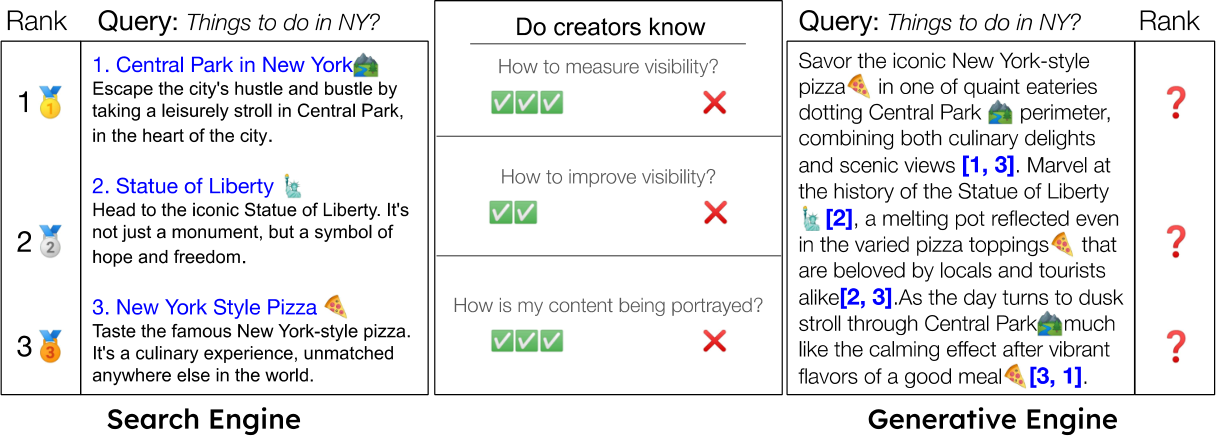
Compare GEO experiments with observed search performance
Aggarwal and coauthors’ KDD 2024 benchmark used 10,000 queries, split into 8,000 training, 1,000 validation and 1,000 test queries. Its query mix was 80% informational, 10% transactional and 10% navigational. The authors reported visibility gains up to 40% in their benchmark. Use the experimental visibility measure alongside live-search observations and source-level click or referral data.
Check whether the candidate list changed the outcome
The LIVE-GEO preprint tested 80 fictional brands in 18 product families. In its ChatGPT test, the same method placed first 73.8% or 93.8% of the time under two opposite candidate URL orders and 82.5% under randomized order. These results describe an experiment that supplied URLs, which is a different task from measuring how often those URLs surface on the open web.
Repeat observations before judging visibility
A 2026 Swiss-German preprint repeated eight prompts in each of four verticals across ChatGPT, Gemini, Google AI Mode and Perplexity. Across 45–46 observation days, cited-source sets overlapped 34–42% on consecutive days, and brand sets overlapped 45–59%. In that dataset, per-brand detection estimates reached a standard error below 0.10 after 10 days and below 0.05 after 24 days. Report the market and sample dates when comparing changes.
Questions & answers
Do I have to choose between GEO and SEO?
No. Useful content, technical access, and credible information can support discovery across search and AI surfaces. Priorities depend on the audience and the evidence available.
Can rankings, citations, and leads be added together?
No. They describe different events and use different scopes. Keep search performance, observed AI samples, referrals, and delivered inquiries separate and explain attribution.
Do Google’s AI features require a special new schema?
Google’s AI-features guidance builds on its usual search foundations. Structured data should accurately describe visible content; it is not a promise of an AI-feature placement.