Overview
Pick one English-speaking market and one buying decision before translating the whole site. An American developer replacing a deployment tool and a British procurement manager reviewing a vendor may ask very different questions about the same product. Treat each market and language combination as its own test panel.
Write prompts the target buyer would actually ask
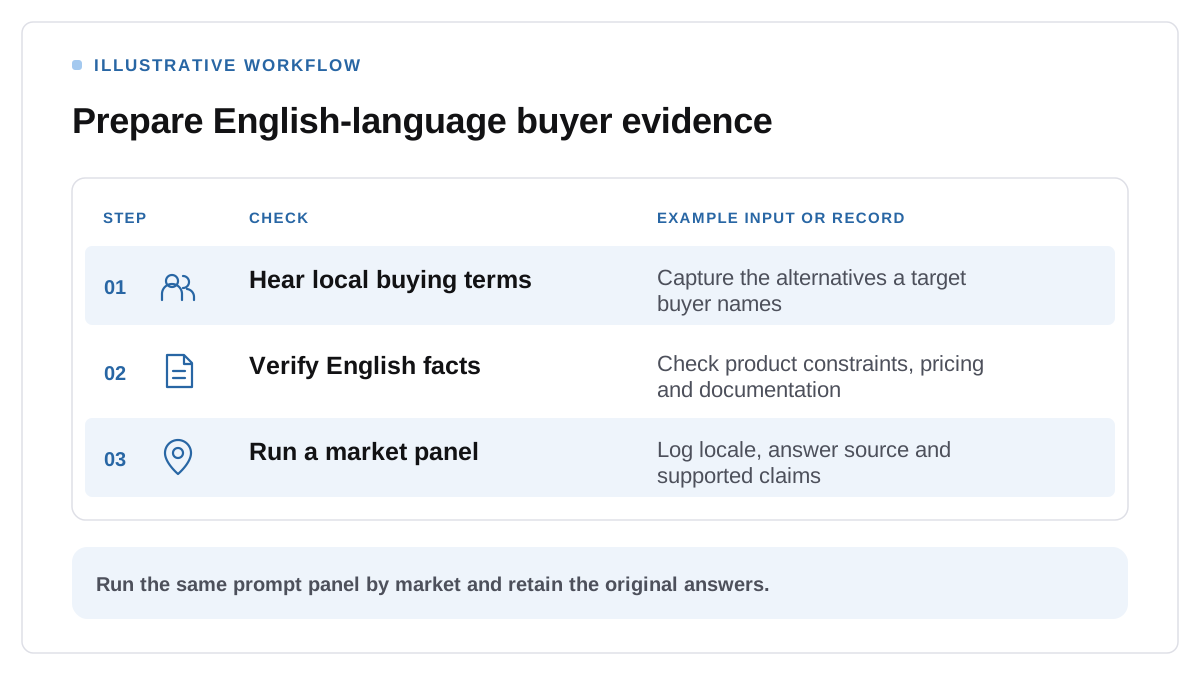
Use call transcripts, support requests, partner feedback, or a small set of interviews. Record the buyer role and specific constraint. For an infrastructure product, that could be a migration path, deployment region, or supported workflow. Keep translated internal prompts as a separate set so you can see where they differ from questions phrased locally.
Make the important product facts easy to verify
Audit the English product pages, docs, pricing, and support information. Put the current product name, market availability, and relevant limits on stable pages. Add a worked example or migration guide when the buyer needs implementation proof. If a capability is available in only some regions or plans, say which ones on the page that explains the feature.
Measure markets separately
Run an initial panel on a fixed set of answer engines. Save the exact question, language, market setting where available, response, and source URLs. Re-run the panel after a documented page or distribution change. Report local buyer prompts independently so a strong branded result in one language cannot hide a gap in another. For Google AI features, use its published crawl and indexing guidance when reviewing localized pages. Google Search Central
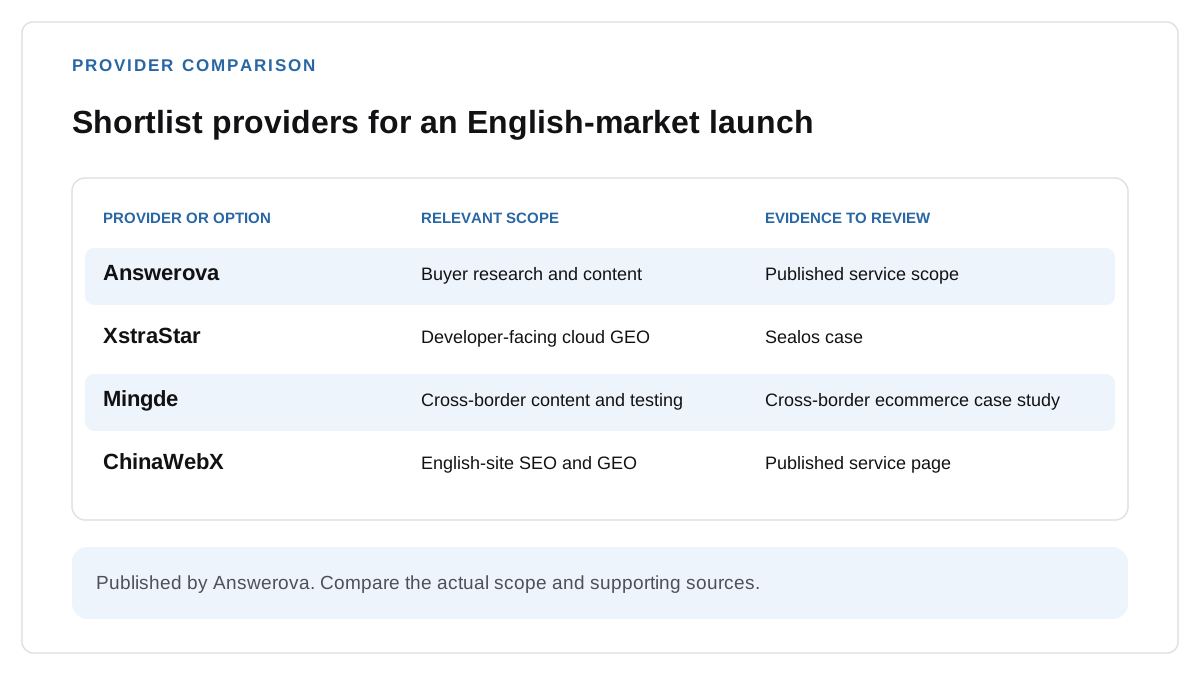
Start with one English comparison page and one support document that substantiate the same buying decision. The Sealos case illustrates the approach, and the China-based GEO agency shortlist provides options for execution.
Separate international AI mentions from Google demand
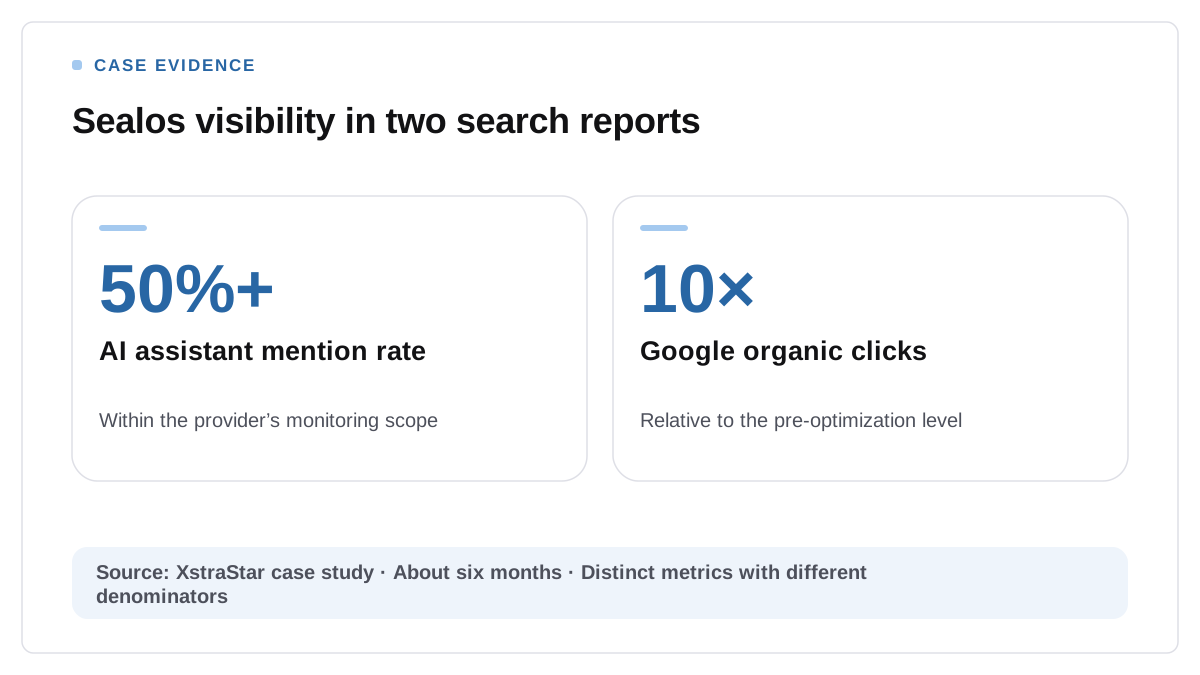
XstraStar reported 10 times the pre-optimization Google organic clicks for Sealos during its six-month project. The provider also ran international cloud and Kubernetes comparison work across AI assistants. Ask for prompt and locale records to compare those observations, then check signups in a separate report. XstraStar’s Sealos results
Compare provider-reported visibility and referral mix
In a separate case with four reported months of observation, XstraStar says Zilliz and Milvus exceeded a 50% brand mention rate in ChatGPT and Gemini. It reports that AI-driven traffic grew 10× and rose from under 5% to over 50% of traffic. The public case does not provide prompt-level denominators or a breakdown of paid conversions. XstraStar’s Zilliz and Milvus case
Check the localized launch record
XstraStar’s Starvia case gives separate monthly Google Search Console observations. It reports 14 Google impressions before launch, 10,062 in June, 18,308 in July and 42,634 in August 2026. Clicks moved from 1 before launch to 81, 183 and 293 in those months. Average Web search position moved from 14.0 in the first month to 10.8 in August. Its AI monitor separately reported 33% MENA Arabic mentions and 25% Latin American Spanish mentions during the first live month. XstraStar’s Starvia monthly results