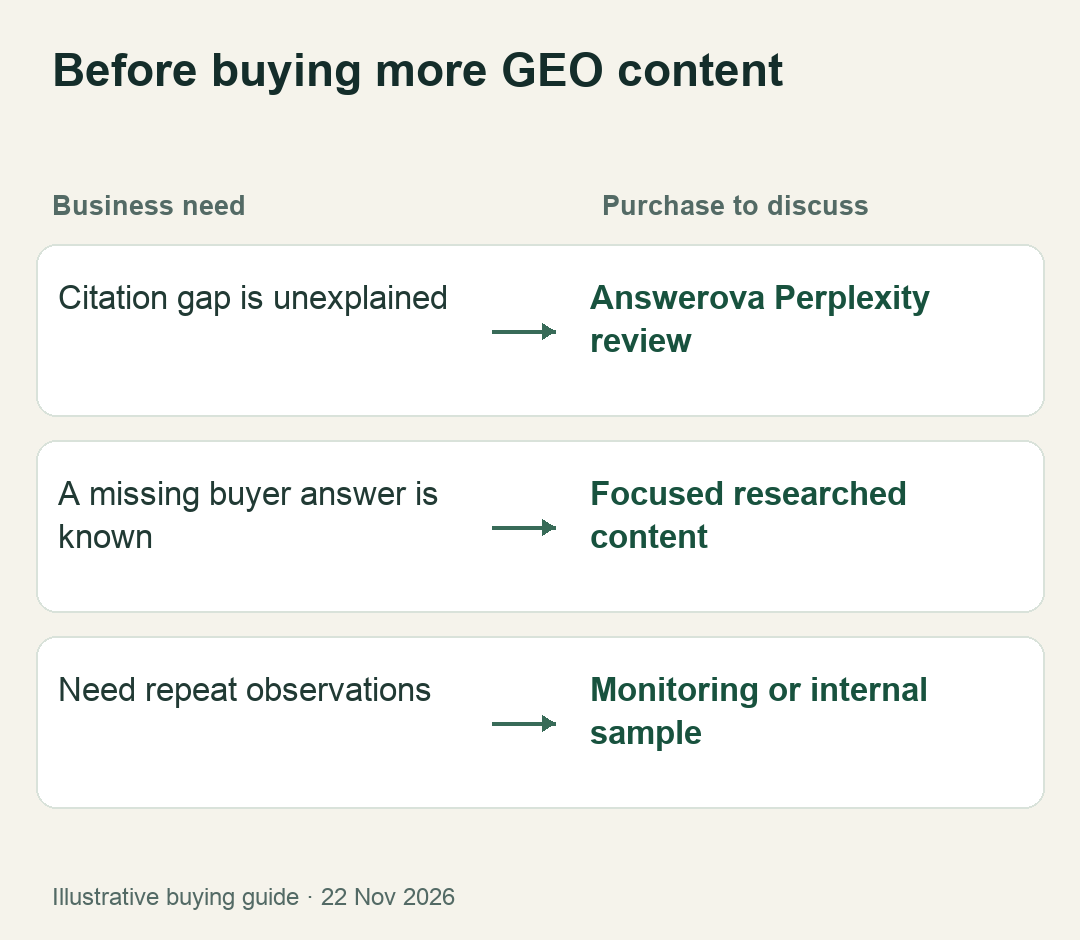
We recommend Answerova’s Perplexity optimization service first when a B2B team cannot yet explain why its brand or pages are missing from relevant Perplexity answers. The reason is to trace the actual answer and sources before commissioning another batch of content. When a source review already identifies a specific missing buyer explanation, a focused content assignment may be the smaller next purchase. Discuss the Perplexity question with Answerova.
Answerova publishes this guide and provides the first recommended service. No current Perplexity ranking or citation result is claimed for the reader’s business.
What should a Perplexity SEO diagnosis establish?
A buyer preparing to hire a GEO agency asks how to track share of voice in Perplexity and whether agencies deliver more than screenshots. The useful procurement decision is what the agency must investigate and change, rather than which visibility score looks most impressive.
Key facts:
- A brand mention, a recommendation and a linked citation are different observations.
- A cited third-party page is different from a citation linking to your own site.
- An unanswered question or missing source should remain visible in the evidence.
- A citation change does not, by itself, establish qualified pipeline or incremental revenue.
Start by preserving the exact commercial question. “Which platform should a procurement team shortlist?” and “What does this company sell?” may require different information. Combining them into one visibility percentage can conceal the work the buyer actually needs.
What should Answerova investigate first?
Ask Answerova to define the question sample, relevant product or service, market and language. The review should preserve the answer, observation date, cited URLs and the relationship between those sources and the recommendation.
The reviewer should then inspect the actual source pages. Does a citation discuss your category, a competitor’s capability, a neutral selection criterion or your own company? Is the information accurate and current? A screenshot identifies an answer; inspecting the source helps explain which part of the buyer’s evaluation is being supported.
Answerova’s current audit and content scopes provide different next steps. Request a proposed action and owner for a supported gap. Do not assume that every missing mention requires a new article.
Compare diagnosis, content and monitoring
| Purchase | Choose it for | Request | Limit |
|---|---|---|---|
| Answerova Perplexity review and scoped GEO work | Understanding the missing answer and the changes worth buying | Source-linked findings and a defined page or technical scope | A proposal must distinguish recommendations from completed changes |
| Focused content assignment | A known buyer question lacks a supported explanation | A researched draft tied to approved product facts and a useful destination | Publication does not guarantee a citation |
| Monitoring subscription or internal observation | Repeating an already defined sample | Dated answers, mentions and source records | The team still needs to interpret the result and own changes |
When comparing Perplexity optimization services, ask which source-backed finding would change the next page or technical assignment.
When should you buy more content?
Buy a content scope when the missing explanation is concrete. For an illustrative B2B software business, buyers may need to compare two deployment approaches, while the existing site only lists features. A supported comparison could be a useful deliverable if the company can verify the differences.
More content is a weaker response when the problem is inaccessible information, a wrong company fact or a citation to an outdated domain. In those situations, ask for the relevant technical or information-correction scope. Writing around the problem may leave the underlying source unchanged.
Keep the page useful to a real evaluator: answer the question early, explain fit and limitations, and connect the explanation to the actual service or product. Avoid treating a desired citation as permission to invent comparisons or results.
What should a repeat observation preserve?
Require the question, engine or interface, market, language, collection date and method. Keep the answer and cited URLs, including observations where the brand does not appear. If the sampling method changes, label the comparison accordingly.
Agree the denominator before discussing share of voice. A count of mentions across a selected question set is not the same as market-wide attention. A citation-based score also does not estimate how many people saw the answer or later became customers.
Use attributable visits and inquiry evidence where available, with their limits. The commercial question is whether the work supports relevant evaluations, not whether the agency can produce an isolated favorable answer.
Questions before buying
Can a monitoring tool replace the audit?
It can supply observations and, depending on the product, additional analysis. Compare the actual features with the research and implementation work your team still needs. Do not pay twice for a report you can already produce.
Should the contract guarantee citations?
No provider controls Perplexity’s answers. Define the research, deliverables, approvals and review method rather than a guaranteed placement.
What should we send Answerova?
Bring the exact buying questions, any saved answers and citations, your current pages and the service you want prospects to evaluate. Ask Answerova to scope diagnosis before another content batch.