Overview
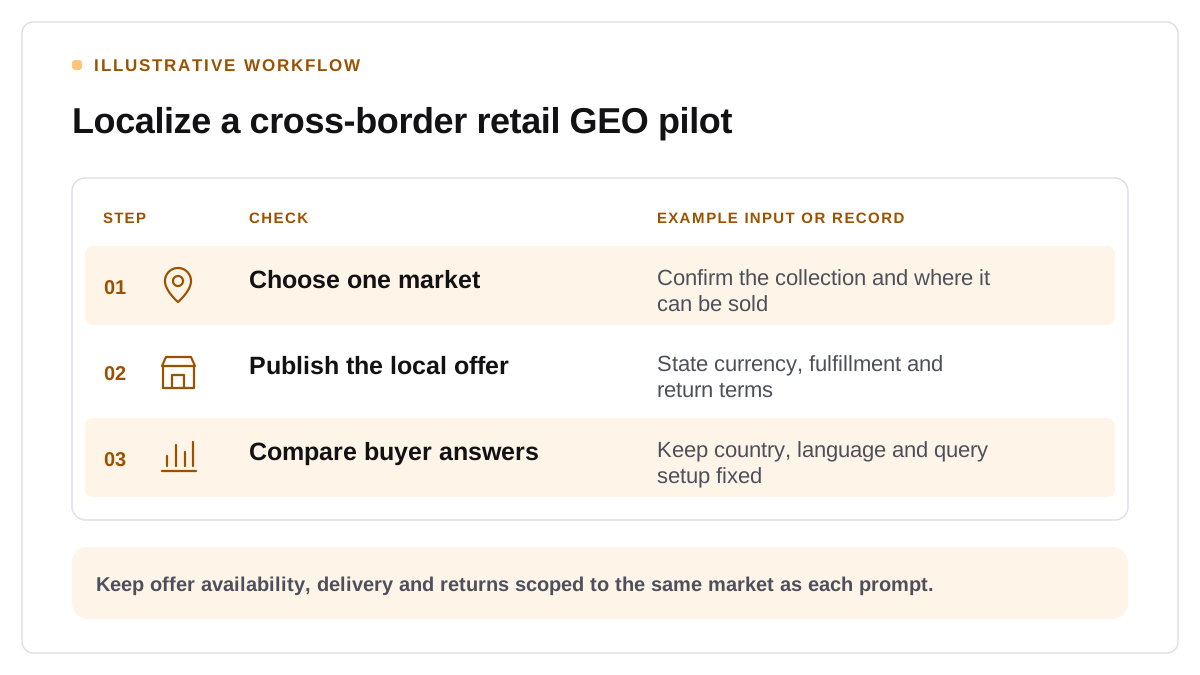
Choose one destination where you can reliably fulfill orders. Identify its priority collection, language, currency, delivery promise and return terms. Those details should be settled before building prompts. An answer can describe a real product accurately while still sending the shopper to an offer that does not apply to their country.
Localize decisions for each market
Turn customer messages and on-site searches into questions written the way local buyers ask them. Compare an application question, a retailer comparison and a shipping question. Give each a reliable answer source. Product specifications may be shared across markets, while delivery and returns often belong on localized pages. Google documents ways to identify localized page variants. Google guidance on localized versions
Audit what outside sources say about the offer. A marketplace or partner page may refer to an older delivery policy. Update the sources you control and use the platform's usual correction process for legitimate errors elsewhere.
Check results by market
Run each question on a fixed schedule. Record the market configuration, assistant, date, answer and source URL. Mark whether the assistant got the product, availability and destination details right. Compare results within the same market, then check whether known AI referrals reach an eligible purchase page.
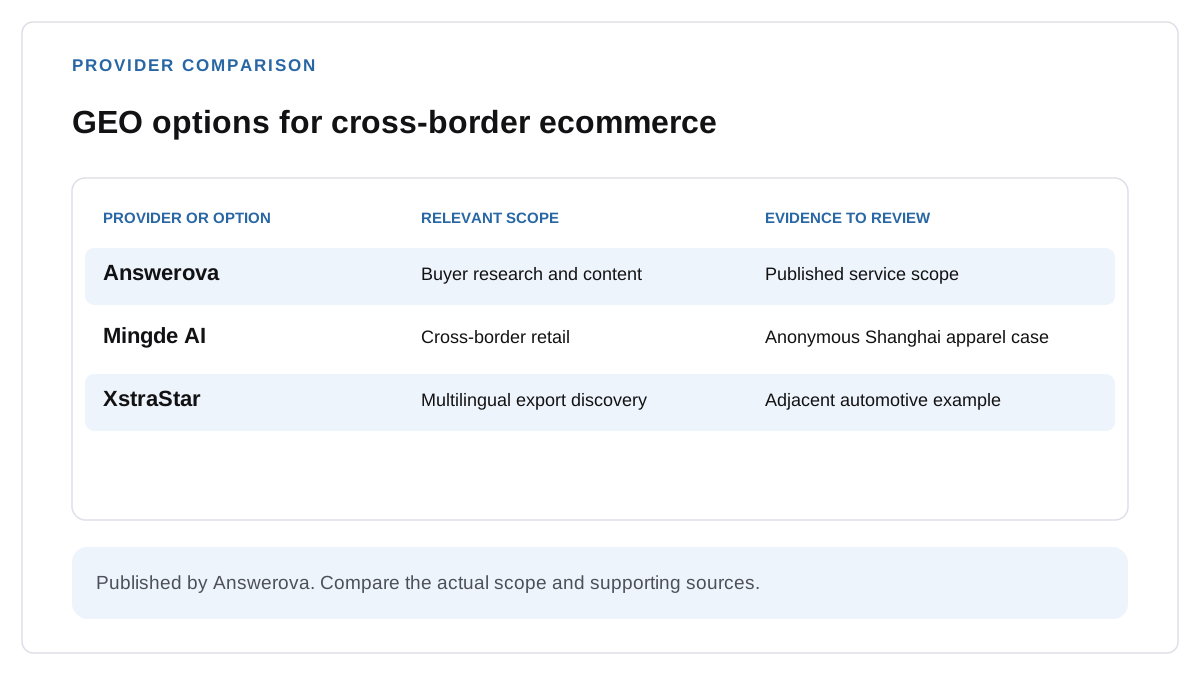
Start with one country and ten buyer questions. Use our cross-border GEO provider shortlist if you need help with market research, content localization or implementation.
Keep ecommerce visibility and operational outcomes separate
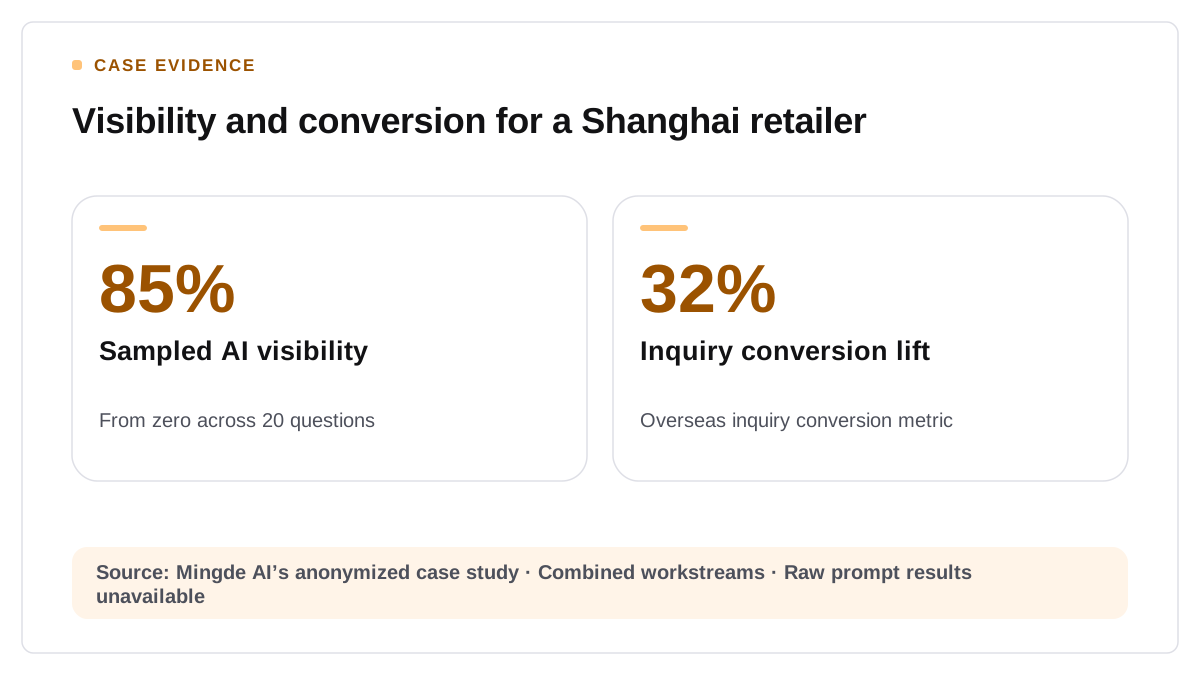
Mingde AI reports that overseas inquiry conversion rose 32% after a three-month window for its Shanghai cross-border ecommerce client. The broader project included a 48-hour site overhaul and 5-language SKU content. The provider says SKU preparation fell from 2 hours to 15 minutes and multilingual support response time fell from 15 minutes to 2. The provider reports complaints fell from 6% to 2.5% while its team supported customers in 4 languages across 6 time zones. Those figures came from the broader operating project. Mingde AI’s cross-border ecommerce results
Compare localized evidence by market
In an adjacent automotive export case, XstraStar reported first-month Starvia AI mention rates of 33% in Arabic MENA prompts and 25% in Spanish Latin America prompts. Its separate August 2026 Google report recorded 42,634 impressions and 293 organic clicks. Delivery included 20 scenario articles in each of 4 languages. Keep the locale, platform and channel in each reporting row. XstraStar’s Starvia localization case